.jpg)
Every sales team has its dream clients: those who need exactly the product you’re trying to sell. Those you’d love to have on your list of references. And, above all, those who can generate good revenue – whether you’re under pressure to meet short-term sales targets or aiming to achieve strategic growth goals.
Let’s be honest: how many such valuable customers do you have? How long do you have to spend sifting through websites and maintaining prospect records during your sales preparation? How many leads are actually valuable in the end – for both sides?
Finding and winning new, high-quality customers is no walk in the park, even with AI, despite what many offers would have you believe: “Forget cold calling! Win new customers with AI and close deals instantly!”
Yes, it’s true: our Sales Agent makes big promises too. Namely, nothing less than the best product-market fit and precise scouting for the most promising leads. Or: customers who are the perfect match for your products.
What sets our sales agent apart from many other AI solutions is its focus on laying a solid foundation for the sales process.
Process:
Behind the scenes, up to 80 different steps are running, all validated through various client projects and requirements. This sales agent was developed based on our day-to-day experience and is designed specifically for this purpose.
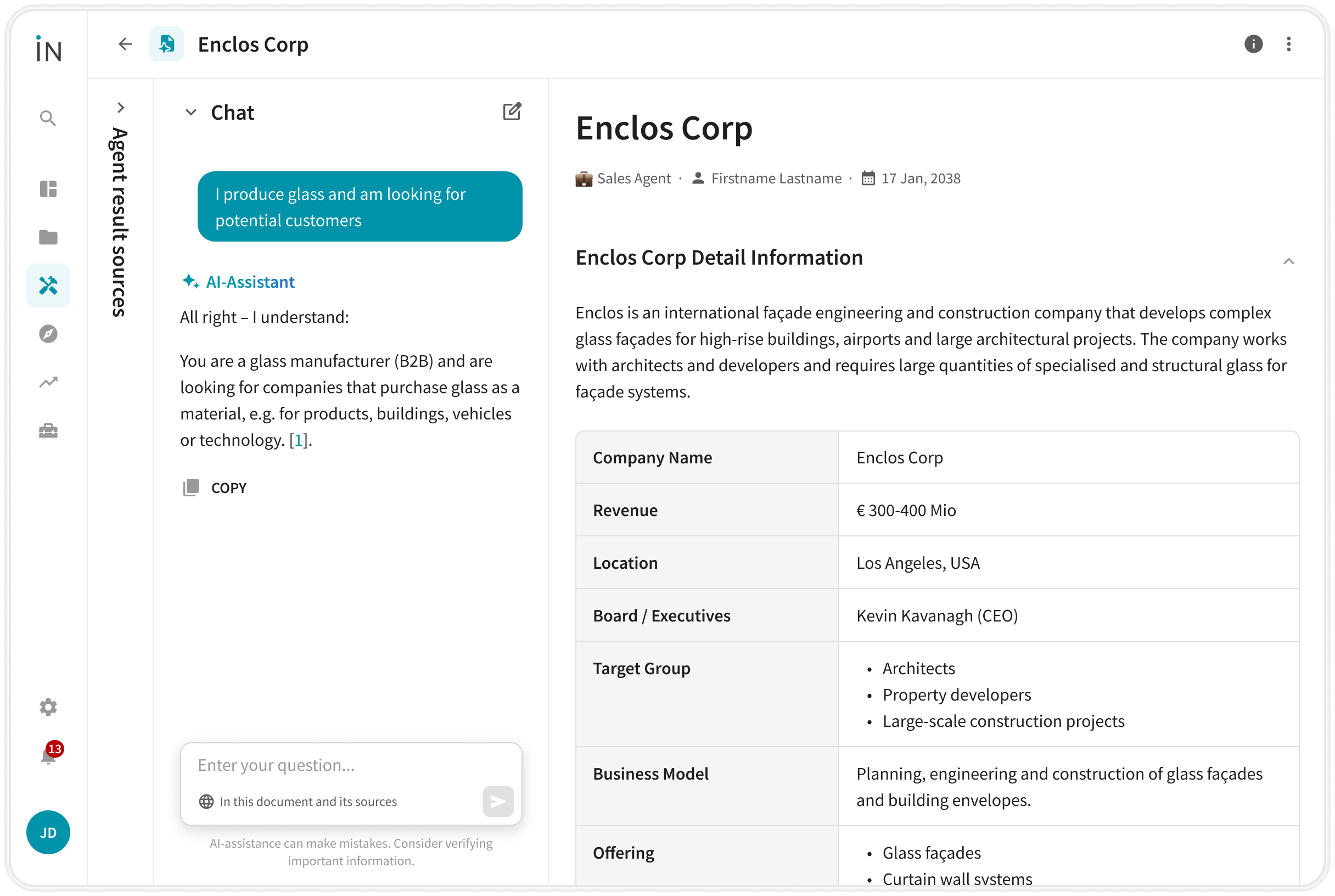
Qualitative analysis based on a solid, verifiable data set facilitates a focused sales approach. It saves endless time spent on research and is more flexible and in-depth (even compared to our own previous templates).
This allows the sales agent to increase the success rate and makes face-to-face customer contact easier.
Because that’s what matters: the sales agent deliberately refrains from intervening where a human touch is required. In B2B, closing a deal relies on good personal conversations and proven expertise. Trust isn’t built through an AI query.
The wow factor is undeniable: “With 20 years of market experience, we’ve discovered companies we didn’t know about – but which are a perfect fit for us!” (Sales Manager at a company in the paper industry)
A sales agent is, of course, even more effective as part of a team. Particularly when it comes to supporting market entry strategies, various departments such as R&D, marketing and sales work closely with senior management.
This is exactly how we would build a team of agents: A second agent researches details on an individual company (by URL or name), delves extremely deeply into the subject and creates a company profile.
Another agent could continue and cross-reference the research with target customers you have already been monitoring elsewhere or have always wanted to take a closer look at.
Interesting: Existing customers can also be examined for upselling potential in this way.
Naturally, this can become quite extensive over time. You can then continue working in the AI Notebook using the chat function, for example:
All the research taking place in the background is stored there. Using the familiar, curiosity-driven question-and-answer logic, you can use the AI Notebook to explore what interests you most about the results:
Next, you could instantly generate a sales pitch presentation.
Your entire AI strategy can be defined and mapped out in our AI Notebook. Multiple tools and agents – from the Trend Radar, which monitors future trends and fosters innovation, to the Research Agent, which keeps an eye on competitors – then work together seamlessly.
Curious about direct insights into our agents? Click here for a tour of the Sales Agent ⬇️

.png)
Complex issues demand concentration, patience, time and exceptional care from people. Whether the subject is technology, chemistry, medicine or economics. You often don’t have that time in day-to-day business – for example, if you are asked to present the latest information on the current state of research and knowledge relating to your project at a colloquium arranged at short notice. But complex research tasks are tailor-made for AI agents! Our Research Agent replicates scientific working methods – orchestrated within a multi-stage thinking and analysis process.
In every sales team, there are target customers: Those who need exactly the product they want to sell. Which you would like to have on the reference list. And especially those with whom you can generate good sales — whether you want to reduce short-term sales targets or achieve strategic growth goals.

Kennen Sie das? Sie sollten sich eigentlich täglich einen Überblick über den Markt, neue Gesetze, den Wettbewerb, neue Technologien oder ähnliches verschaffen. Doch die Informationsflut ist überwältigend und unübersichtlich, Quellen werden undurchsichtiger und fragwürdiger. Und die Zeit für ein kontinuierliches Monitoring fehlt sowieso. Unser KI-Agent „Monitoring Feeds“ ist genau dafür gemacht – für die kontinuierliche Überwachung von Trends, Technologien und Wettbewerb.