One foundation for all your AI applications: agents, data access, costs and records sit in one place. You run it in your own data centre or in a European cloud.


The prototype convinces in the workshop. For daily use it lacks approvals, monitoring and a way to stop an agent again.
Usage only becomes visible on the monthly invoice. Which department caused it is not stated there.
Three departments, three contracts, three sets of rules. Nobody can say who accesses which data where.
Risk classification and logs cannot be produced retroactively. The question usually comes up in the first audit.
We see these four points in almost every project before we start. It is rarely down to the teams.
One foundation instead of four building sites: agents run under control, access is approved, and the records are created where the work happens. From the first installation, at no extra cost.
Your own data centre or a European cloud. You switch models and providers by configuration.
Prioritised queues, load balancing and an automatic restart after a failure.
Its own container, its own identity from tenant and role.
A manifest defines what an agent may do. An administrator grants approval.
With SDK and CLI, no matter who carries out the work.
Watch, test, log and configure agents without switching tools.
Legal, finance and IT work with the same data, each with the view that allows decisions. Without spreadsheet exports and without asking around.
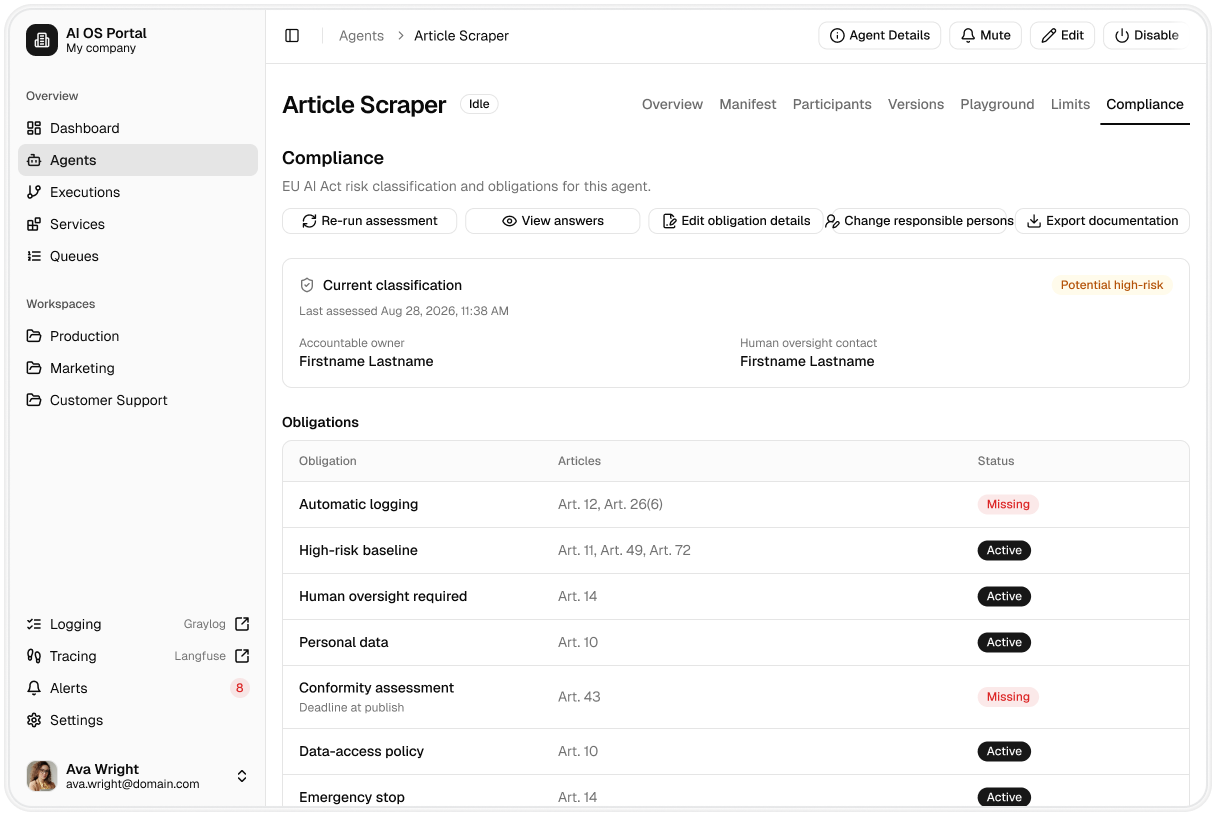
Every agent is assigned a risk class under the EU AI Act. Decision paths are logged so they can be followed, and the logs can be exported. You see the current state continuously instead of assembling it before an audit.
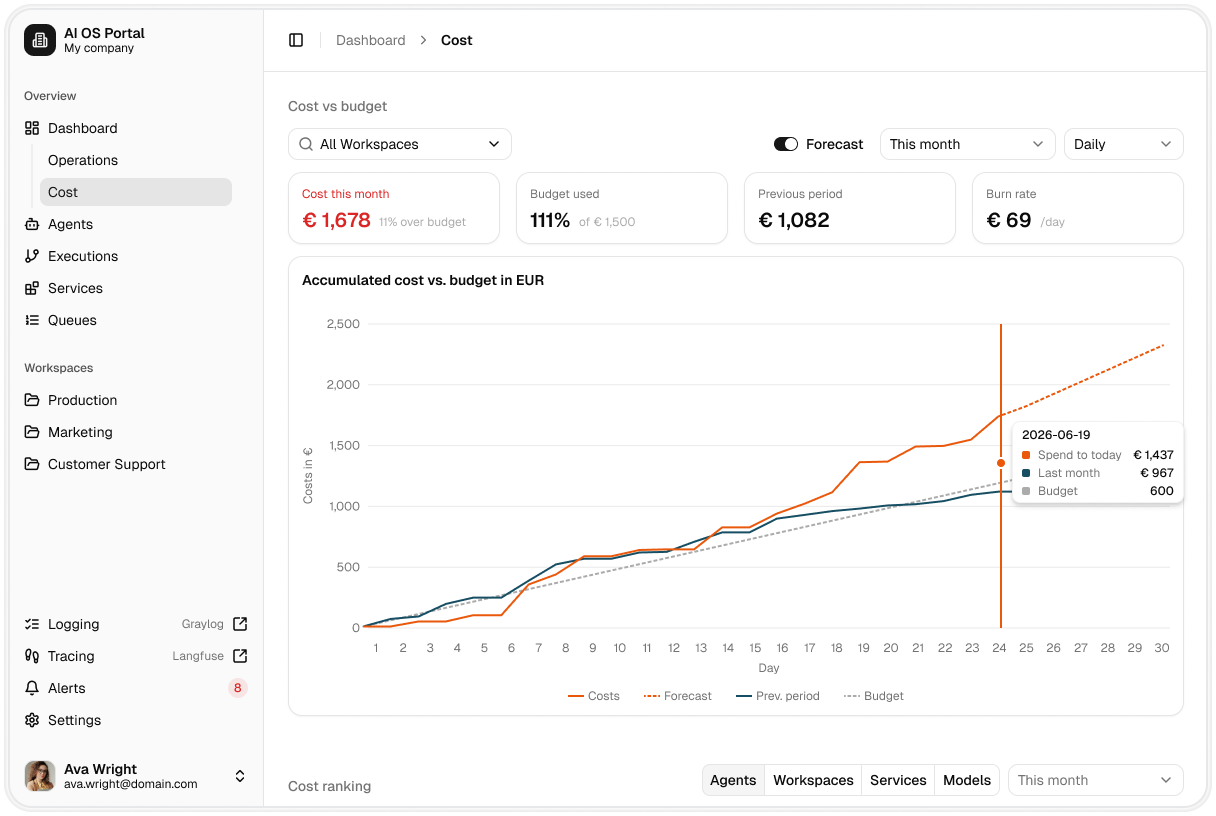
You see what each agent costs, per team and per department. Budgets apply firm limits before they are exceeded. Forecast and comparison with the previous year are the basis for allocation.
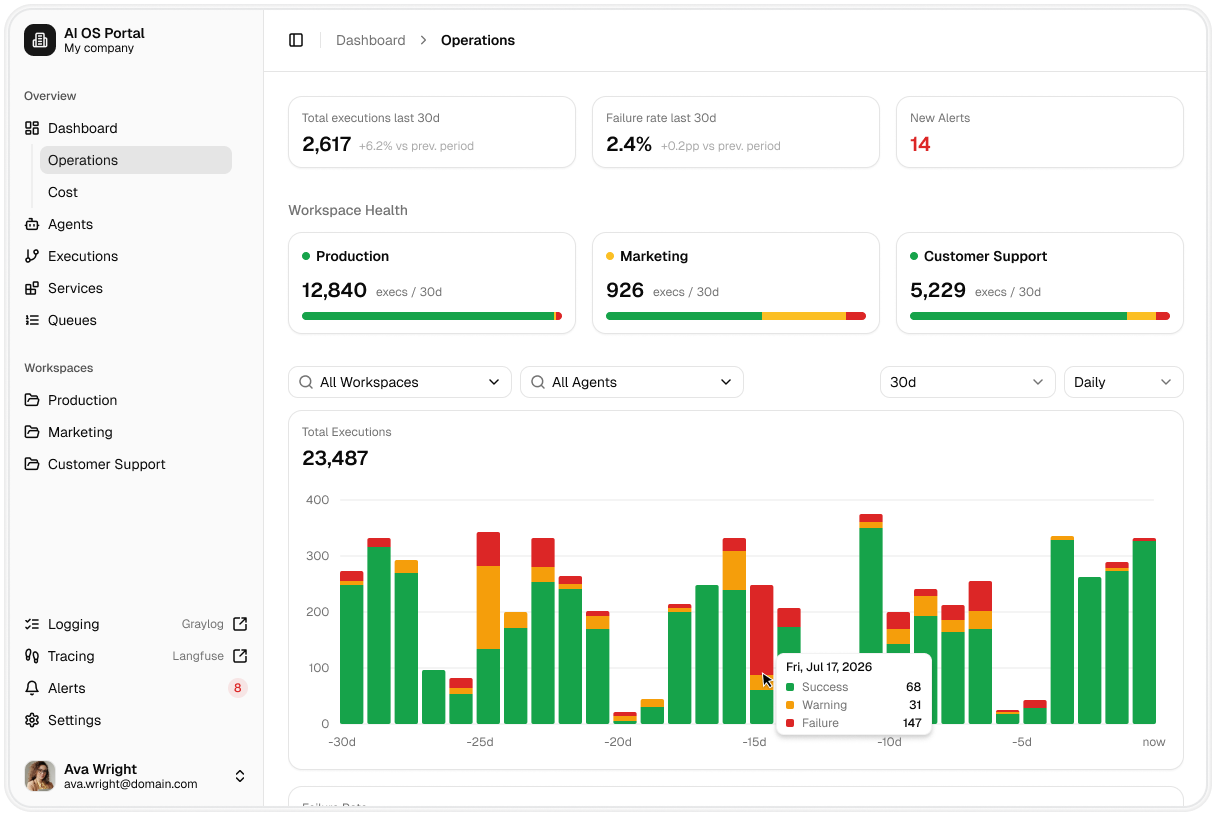
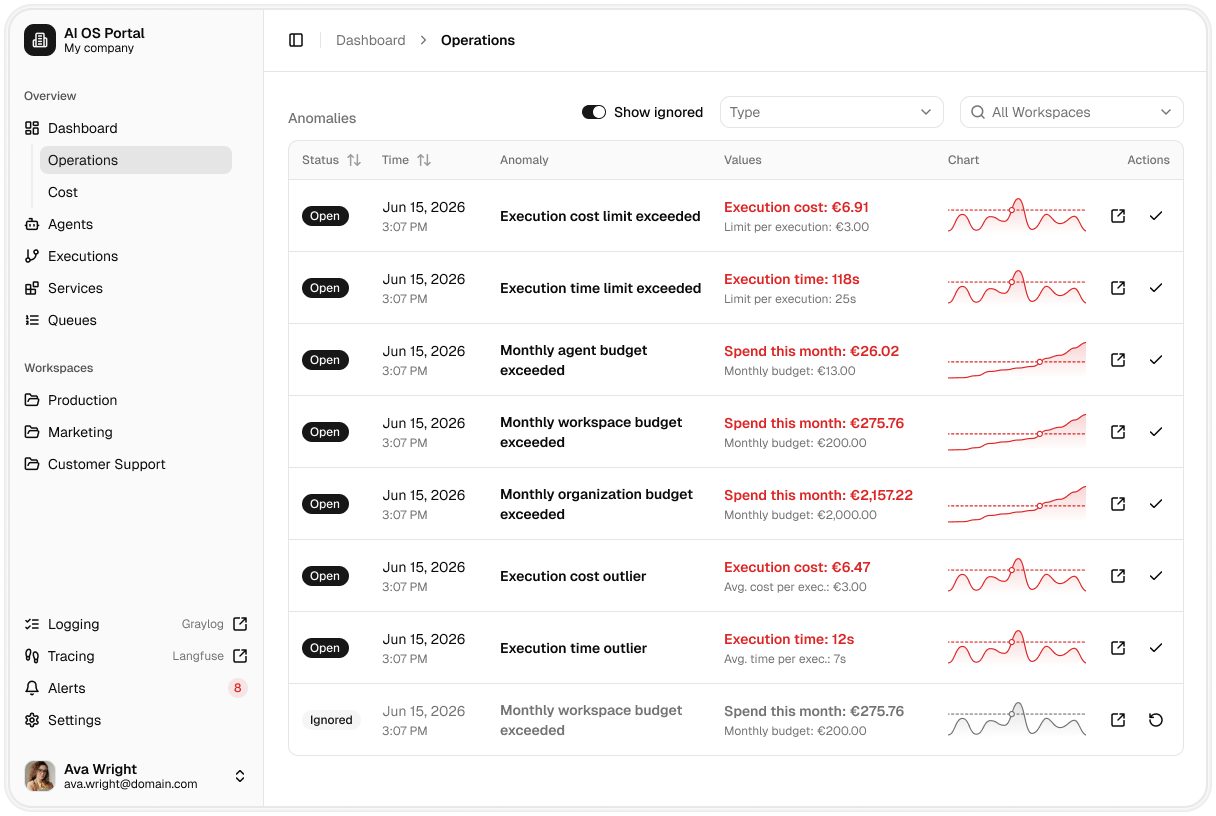
System health, executions and errors in real time. Anomaly detection reports unusual behaviour before users notice it.
The AI Readiness Check asks you eight questions that you can answer without your technical team. You receive a reasoned assessment, your three biggest gaps and a suggestion of what to tackle first.
With AI support, your team writes an agent in minutes. All it takes is someone who knows exactly what the agent should do. The result is real code: versioned, tested and your property, with no ceiling on what it can do.
Your agents remain your property. No editor sets the limit.
In your other systems this is taken for granted: your data sits in one central place, not in the front end. The same applies to AI.
When the interface changes, knowledge, rules, logs and costs stay the same.
From first pilots to daily use: the Sovereign AI OS runs today in large, regulated companies.
Individual therapy recommendations based on official guidelines. A certified medical device, built together with TUM and Göttingen. Doctors decide faster, and patients receive the therapy that fits.

Their own agents track changes in the legal environment continuously. The team reviews results instead of collecting sources.
Agents research suitable customers and prepare market strategies. Sales go into the conversation with the groundwork done.
A partnership with the EURAC research institute and its more than 400 researchers. Together we build tools and agents for daily research work.
We look at your systems and tell you honestly whether the Sovereign AI OS fits you. We look forward to the conversation.
Book an initial meetingA company GPT is an application: a chat window in which the knowledge base, rules and history are configured and also stay. The Sovereign AI OS is the layer beneath. A company chat runs on it, and so does your own specialist application or an agent inside one of your existing systems. So you do not get one interface, you get the foundation for any number of them.
Headless means that the Sovereign AI OS does not bring a fixed interface with it. It provides the functions, and you decide where they appear. We supply the company chat and specialist applications on request, but you can just as well connect your own application or bring AI directly into your existing systems. When the interface changes, knowledge, rules, logs and costs stay the same.
A chatbot answers questions. An agent completes a task: it accesses defined data and tools, works through several steps and delivers a result, often without anyone watching. An agent for offer review reads an incoming offer, compares it with your terms and files the result in the target system. Because agents act independently, they need approvals, logs and a budget.
The assistant can stay. The question arises with the second and third use case, because otherwise every further department brings its own tool, its own rules, its own costs and its own logs. The Sovereign AI OS puts these things in one place, so that every further project builds on what is already there. Often the existing assistant simply keeps running while agents and specialist applications are built on the new foundation.
Both are possible. You run the Sovereign AI OS in your own data centre, or we run it for you in a European cloud. The range of functions is the same in both cases. The difference lies in who provides the infrastructure. A later switch is possible, because agents, rules and logs are not tied to where it runs.
Sovereign means that you keep control at four points: the contracting party, the infrastructure, the place where models run, and the control and logging layer. The Sovereign AI OS runs in your data centre or in a European cloud, and your data does not leave that boundary. Switching model or provider is a configuration change, not a project.
Agents are created as software, with SDK and CLI, in the language and with the tools your team already uses. As a result there is no ceiling on what an agent can do, because no editor dictates the range of functions. Versioning, automated tests and rollback are part of it, and they are what make an agent ready for production in the first place. The agents belong to you, they live in your repository, and your team or any partner can develop them further.
As a rule it starts with both. You license the Sovereign AI OS, we provide it, configure it and put it into operation in your environment. Everything after that is your decision: you can develop agents and integrations yourself, commission us, or bring in a partner. The licence is not tied to our consulting work.