
Does this sound familiar? You really should be keeping a close eye on the market, new legislation, the competition, new technologies and the like on a daily basis. But the flood of information is overwhelming and confusing, and sources are becoming increasingly opaque and questionable. And you simply don’t have the time for continuous monitoring anyway.
It’s obvious that AI agents can help here. But, as is so often the case, the devil is in the detail: How do I set up such an agent? How do I structure the results? How do I ensure that the results are reliable and secure? And how do I map this out so that it aligns with our company’s information processes?
Our AI agent ‘Monitoring Feeds’ is designed precisely for this – for the continuous monitoring of trends, technologies and the competition. Here’s how it works:
Whether it’s the latest product developments in a specific industry, changes in legislation, weather data or monitoring the competition: our Monitoring Agent can be used for virtually any topic.
Firstly, the agent continuously searches a wide range of publicly accessible sources on the internet, such as websites, specialist or news portals, RSS feeds and open databases.
In addition, we can integrate further individual sources and data behind logins or paywalls, such as press databases or knowledge bases within networks. Or documents and databases in other departments of your own company, to make better use of internal knowledge.
The AI agent automatically recognises which content matches the previously defined subject areas. It identifies relevant developments, trends or changes almost in real time.
The results are then filtered by relevance and presented in a curated overview, the feed: intelligently pre-sorted and organised, scrollable and clear.
A particular advantage of our agent for monitoring feeds lies in its flexibility.
You yourself define …
This results in highly customised information flows that are precisely tailored to the requirements of your department or organisation.
Another practical feature: monitoring runs according to custom schedules or monitoring intervals (e.g. weekly or monthly) without the process having to be manually triggered each time.
This ensures that you, as a decision-maker or project manager, are always up to date and can identify changes at an early stage – ideally faster than the competition.
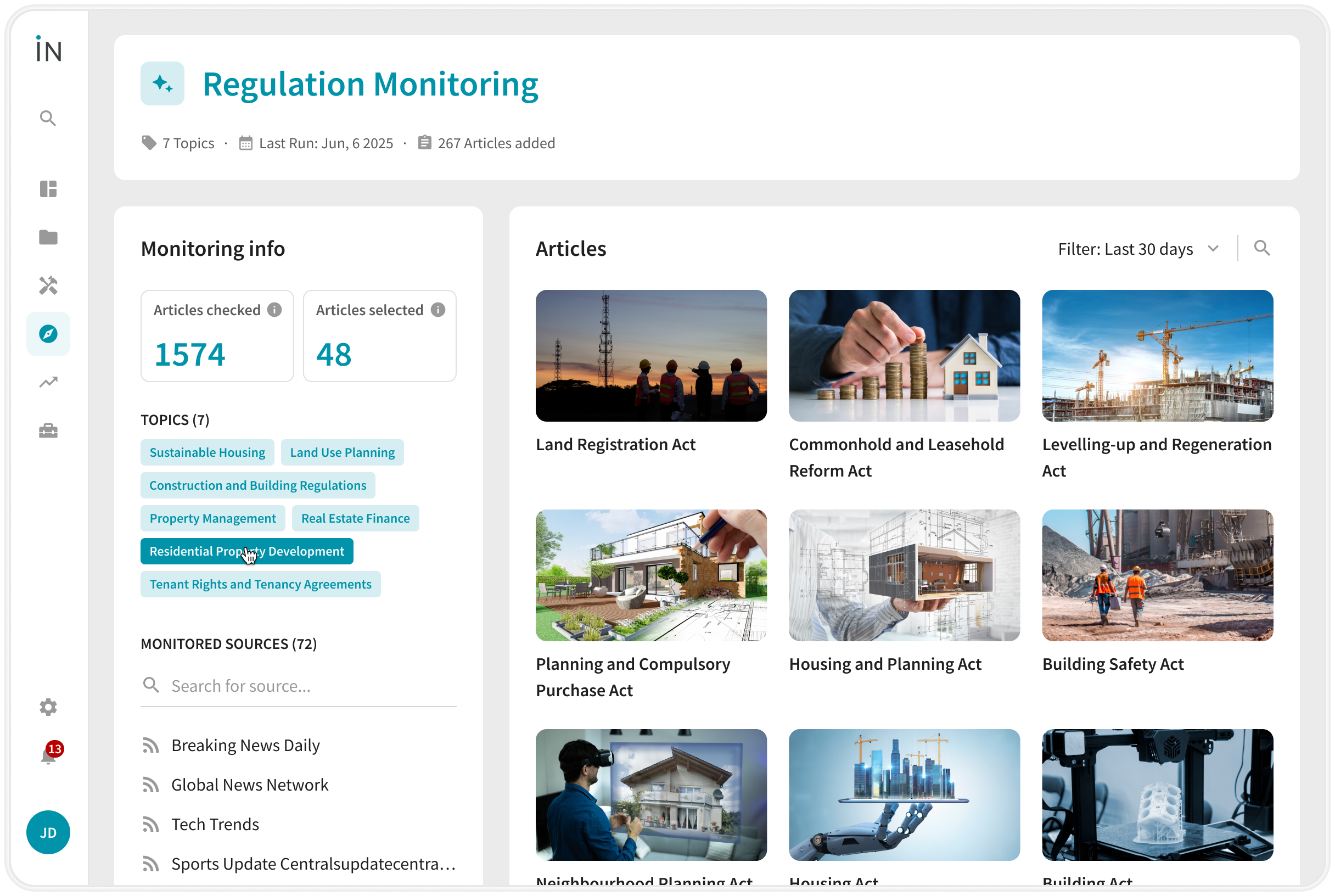
We set up a monitoring agent for the real estate department of a German group to track legal developments.
This involved utilising legal databases and publications such as the European Union’s EUR-Lex RSS feeds – with the aim of identifying changes to tenancy, property purchase and tax law at an early stage and being able to adapt accordingly.
As soon as the agent identified a new legislative change, it automatically generated a structured analysis:
The AI then automatically assessed whether and to what extent the change might be relevant to the company.
For the lawyers, this meant a significant gain in efficiency: instead of having to regularly check numerous sources themselves or have them checked, and thereby risking that something important might be overlooked, they now receive all relevant changes directly on their desks.
The agent-based monitoring workflow runs fully automatically in the background, with intervals tailored to internal requirements.
Particularly if you work in fields such as law, regulation, technology or marketing, AI agents can make a valuable contribution to monitoring in these dynamic times when events are unfolding at a rapid pace.
Would you like to find out how your information processes can be automated and how the monitoring agent can track relevant developments in your areas of interest? We look forward to discussing this with you!
.png)
Complex issues demand concentration, patience, time and exceptional care from people. Whether the subject is technology, chemistry, medicine or economics. You often don’t have that time in day-to-day business – for example, if you are asked to present the latest information on the current state of research and knowledge relating to your project at a colloquium arranged at short notice. But complex research tasks are tailor-made for AI agents! Our Research Agent replicates scientific working methods – orchestrated within a multi-stage thinking and analysis process.
.jpg)
In every sales team, there are target customers: Those who need exactly the product they want to sell. Which you would like to have on the reference list. And especially those with whom you can generate good sales — whether you want to reduce short-term sales targets or achieve strategic growth goals.
Kennen Sie das? Sie sollten sich eigentlich täglich einen Überblick über den Markt, neue Gesetze, den Wettbewerb, neue Technologien oder ähnliches verschaffen. Doch die Informationsflut ist überwältigend und unübersichtlich, Quellen werden undurchsichtiger und fragwürdiger. Und die Zeit für ein kontinuierliches Monitoring fehlt sowieso. Unser KI-Agent „Monitoring Feeds“ ist genau dafür gemacht – für die kontinuierliche Überwachung von Trends, Technologien und Wettbewerb.