.png)
How much of your life have you already spent reviewing and analysing studies, specialist literature and academic documents? How long did it take you to come up with a sound answer to a complex academic research question?
Complex issues require concentration, patience, time and exceptional care. Whether the subject is technology, chemistry, medicine or economics.
In day-to-day business, you often don’t have the time for this – for example, if you’re asked to present the latest information on the current state of research and knowledge relating to your project at a seminar arranged at short notice.
But complex research tasks are right up the street of AI agents!
Our Research Agent replicates scientific working methods – orchestrated within a multi-stage thought and analysis process.
We all know that the better the prompt, the better the result. The Research Agent helps right from this first, crucial step: it searches for the most effective way to phrase the research question.
It evaluates your input in terms of quality and precision. If the question is unclear, it suggests improvements and offers several alternative phrasings – whether to better reflect the research topic and/or to improve searchability in academic databases. Once formulated correctly, the research question can then be reused.
This quality assurance at the start of the process is crucial: a precise, well-formulated research question leads to better and more reliable results.
Now the actual research phase begins. The Research Agent searches academic search engines and literature databases such as Semantic Scholar or OpenAlex. It identifies relevant publications and collects structured metadata (studies, authors, citations).
In doing so, these results are not merely collected but also dynamically and intelligently evaluated – a key quality feature of our Research Agent.
Based on individually defined evaluation criteria, the agent reviews and analyses the publications found, e.g.: How up-to-date is the study? Is the methodological quality of the study assured? What methods were used to avoid systematic errors and bias? How relevant is the publication to the research question? This is because many AI research tools that lack this filter also include irrelevant or outdated studies, thereby distorting or compromising the results.
Once identified, the sources are then ranked and prioritised according to these criteria. Only then are they incorporated into the analysis process.
All sources used are documented transparently – the chain of reasoning remains verifiable and traceable at all times.
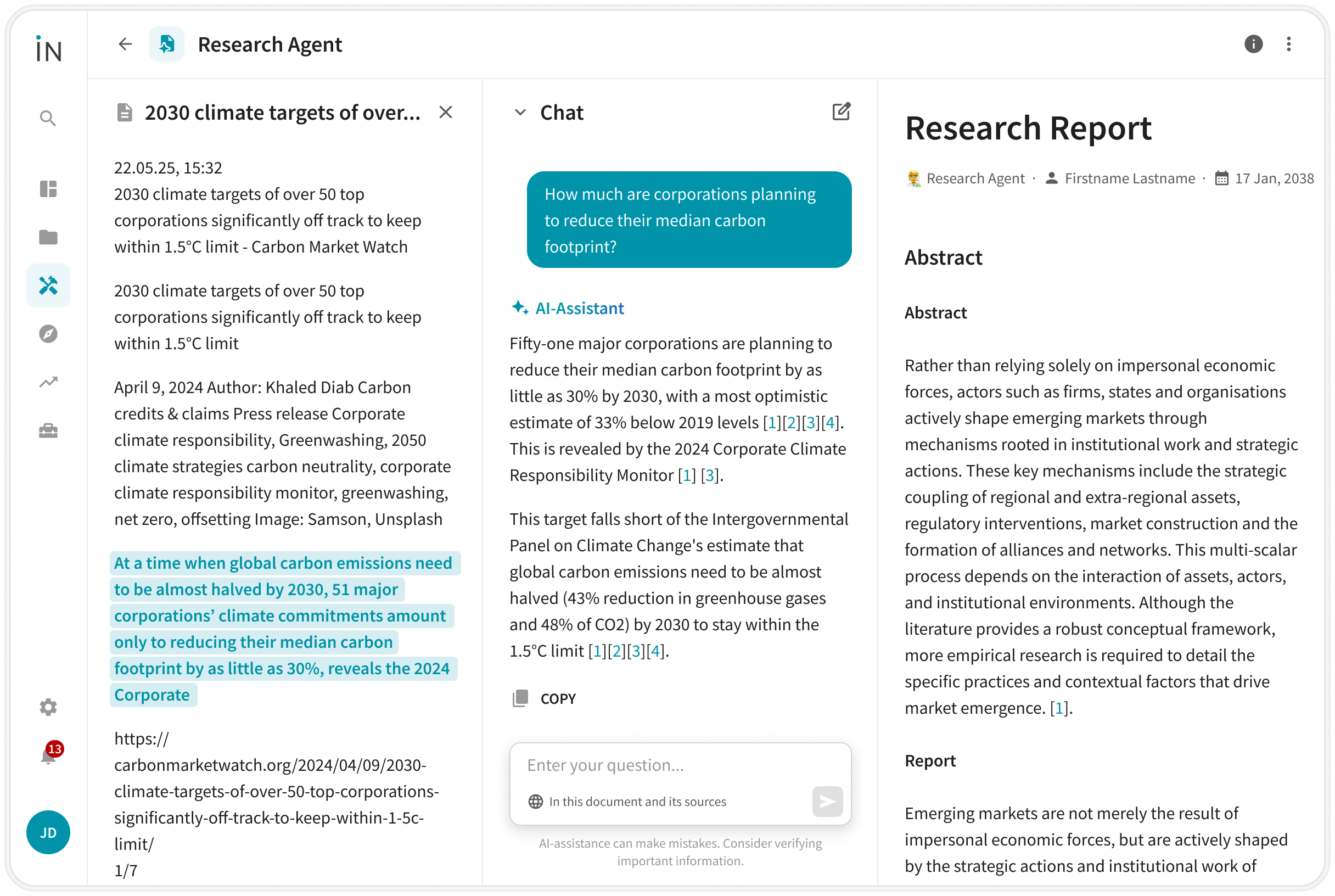
To link external academic literature with existing internal knowledge, documents and knowledge databases belonging to the institute or company can be integrated. These are incorporated via ‘Retrieval Augmented Generation’ (RAG library / RAG search).
They are considered specialised, trustworthy sources within your own organisation – ranging from your own case studies and trend analyses, through notes from research projects and knowledge bases containing product information, to reports that have already been produced.
This can, of course, also include your own research knowledge, e.g. papers that already contain initial findings or your own relevant collections of sources that you use time and again. It can also include studies that have been started but which you wish to continue working on and upon which new research is to be based.
Thanks to all this thorough preparation, the result of the analysis is not a loosely collected set of findings, but a structured, clearly presented research report that follows established scientific conventions.
Including the AI logic used: all steps carried out by the agent are clearly visible and can be directly traced.
Of course, you can further edit this output in an editing mode, whether to refine headlines or add your own thoughts.
As a user of our AI Notebook, you can add it to your sources to interact with it, chat with it and develop its ideas further. It is available within an integrated, circular workflow for your next research tasks.
By coordinating the entire analysis process – from the initial question through literature research to a structured report of academic quality – the agent significantly speeds up research work. In other words: what used to take days or weeks can now be completed – depending on the scope and complexity of the task – within minutes or hours.
In addition to speed, the scalability of the research is also significant: well-founded initial analyses can be produced simultaneously for different research areas.
Ultimately, this also enhances the quality of research outcomes: you not only gain a fresh perspective on familiar topics easily, but can also quickly gain an overview of entirely new research areas and take current developments into account.
Both in-house and global scientific knowledge becomes significantly easier to use: your organisation can react more quickly to developments and trends and build a research lead. Research teams gain a faster overview of the state of research and can shorten development times.
With our Research Agent, AI becomes an amplifier of scientific work within the company, a valuable tool that supports teams and makes them better.
Complex issues demand concentration, patience, time and exceptional care from people. Whether the subject is technology, chemistry, medicine or economics. You often don’t have that time in day-to-day business – for example, if you are asked to present the latest information on the current state of research and knowledge relating to your project at a colloquium arranged at short notice. But complex research tasks are tailor-made for AI agents! Our Research Agent replicates scientific working methods – orchestrated within a multi-stage thinking and analysis process.
.jpg)
In every sales team, there are target customers: Those who need exactly the product they want to sell. Which you would like to have on the reference list. And especially those with whom you can generate good sales — whether you want to reduce short-term sales targets or achieve strategic growth goals.

Kennen Sie das? Sie sollten sich eigentlich täglich einen Überblick über den Markt, neue Gesetze, den Wettbewerb, neue Technologien oder ähnliches verschaffen. Doch die Informationsflut ist überwältigend und unübersichtlich, Quellen werden undurchsichtiger und fragwürdiger. Und die Zeit für ein kontinuierliches Monitoring fehlt sowieso. Unser KI-Agent „Monitoring Feeds“ ist genau dafür gemacht – für die kontinuierliche Überwachung von Trends, Technologien und Wettbewerb.