
Is your company one of those that, just a few years ago, wouldn’t have even considered using artificial intelligence? Today, nearly 60% of companies in the DACH region are experimenting with AI agents. Between 10% and 30% are already using AI in production.
For positive effects to materialise – e.g. on productivity, costs, efficiency, objectives or market position – AI agents must work in a targeted manner.
Unlike with a ‘normal’ IT implementation, AI agents are often the driving force themselves. Some creep in ‘from the bottom up’ – the notorious ‘Shadow AI’ – and transform the business without a strategy. Other siloed solutions may well handle tasks efficiently, but they follow different guidelines or do not support the company’s or organisation’s strategy in a comprehensible way.
Or to put it another way: various tools or agents, initiated by various employees and pursuing various micro-goals, are already active in your company without IT or senior management being aware of any of it.
These phenomena need to be ‘captured’ and put to use – as they often contain value-driving ideas – or replaced with a better, strategic solution.
For example, through a multi-agent system that operates reliably, in compliance with data protection regulations and effectively. And this is how the agents do it:
If we think of AI agents as ‘digital employees’, then agent-based systems are digital teams or departments comprising several such employees who, ideally, communicate with one another. And language models, AI chatbots, pattern recognition and image recognition systems are the digital assistants. Depending on their capabilities and setup, AI agents are assigned specific tasks and carry out work autonomously.
“Autonomously? Isn’t that going too far? What if the AI does something that harms the company?”
No, because by incorporating current agent technologies, we connect the AI models to secure data via various interfaces and abstract the complexity in advance – for example, through tool use (standardised access to functions and systems) or via the Model Context Protocol (MCP). MCP is an interoperability standard through which systems from different providers can be connected and structured contexts provided for Large Language Models (LLM) – such as Figma files, code repositories, SharePoint documents or Notion tasks. This enables secure integration across system boundaries without the need to implement each connection individually.
At the same time, we control the permissions: the AI agent, so to speak, waits for approval before accessing sensitive (e.g. budget-related or public) resources.
On this basis, internal AI agents can go significantly further than an external chatbot. Instead of merely answering individual questions or helping with a task, they plan actions themselves within the specified framework. They implement these using tool use and connected systems without the need for constant human control.
In that case, it’s not ‘spooky’ at all, but harmless in practical application. Because AI agents operate in a transparent manner:
But we have also found that, for businesses, less creativity and more reliability are often more appropriate than autonomy. By clearly defining and testing the individual steps the agent is required to carry out, the result is all the more effective and precise.
This is another reason to set up the workflow of the AI agent(s) precisely in line with the company’s strategy – and not (just) for individual employees.
Agentic Loops – the cycles of reflection and iteration, also known as ‘Re-Act’ (Reasoning and Acting) – are particularly fascinating. This is where agents differ not only from simple chatbots but also from conventional software – and it is what makes the technical solution so robust and efficient.
After each step, the AI agents check whether the result is good and whether the approach has achieved the goal in the best possible way. And if not, they identify what mistakes were made. They learn from their mistakes and adapt their approach until they can perform their task optimally. This happens without programmers having to intervene and make adjustments.
As a result, AI agents deployed strategically in the right areas of a company or organisation are well-suited to boosting efficiency: for the recurring, self-optimising execution of tasks.
This also helps people: AI agents take a huge load off human teams. They experience less stress, have to carry out less time-consuming manual work, and can devote their efforts to more valuable, exciting tasks – resulting in higher quality and greater satisfaction.
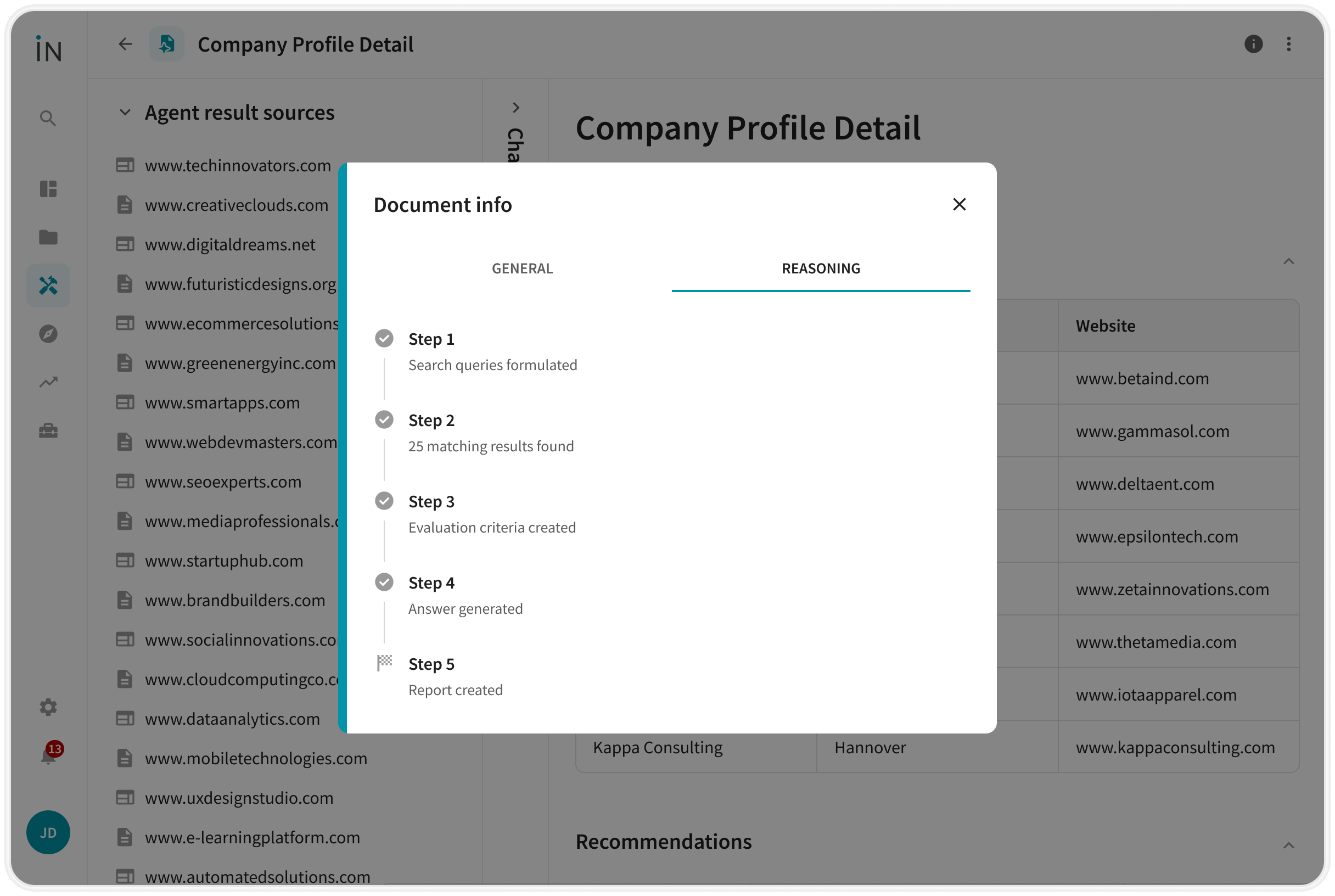
AI agents can be carefully integrated into almost any day-to-day work routine. General quality assurance is achieved, for example, through robust guidelines, individual source verification and evaluation against defined criteria.
The human-in-the-loop approach helps to minimise errors and risks – such as those arising from unrecognised, changed conditions or AI hallucinations.
In this process, humans monitor critical steps: in our example above, specialists could be involved to carry out quality assurance before the results are sent to external stakeholders such as auditors or supervisory bodies. Alternatively, the AI agent highlights uncertain data and sends it to a human as an intermediate step for verification.
A “Human-ON-the-Loop” concept is also conceivable, where a human can intervene at any time and halt the process when dealing with particularly sensitive tasks.
Ideally, the task is tailored to the standard processes within the company or organisation. In other words, it is formulated in such a way that, just as in ‘real life’, the AI directly requests the involvement of defined teams for sensitive matters, e.g. for finance or legal affairs.
To address our clients’ recurring requirements and queries, we have developed a number of ready-made, out-of-the-box, specialised AI agents.
These vertically integrated agent systems are tailored to a specific industry or clearly defined business processes and are equipped solely with the relevant data, tools and rules.
Our most popular AI agents handle workflows in sales and market research from start to finish.
Curious about how the individual agents work? We’ve linked some articles where you can delve deeper.

.png)
Complex issues demand concentration, patience, time and exceptional care from people. Whether the subject is technology, chemistry, medicine or economics. You often don’t have that time in day-to-day business – for example, if you are asked to present the latest information on the current state of research and knowledge relating to your project at a colloquium arranged at short notice. But complex research tasks are tailor-made for AI agents! Our Research Agent replicates scientific working methods – orchestrated within a multi-stage thinking and analysis process.
.jpg)
In every sales team, there are target customers: Those who need exactly the product they want to sell. Which you would like to have on the reference list. And especially those with whom you can generate good sales — whether you want to reduce short-term sales targets or achieve strategic growth goals.

Kennen Sie das? Sie sollten sich eigentlich täglich einen Überblick über den Markt, neue Gesetze, den Wettbewerb, neue Technologien oder ähnliches verschaffen. Doch die Informationsflut ist überwältigend und unübersichtlich, Quellen werden undurchsichtiger und fragwürdiger. Und die Zeit für ein kontinuierliches Monitoring fehlt sowieso. Unser KI-Agent „Monitoring Feeds“ ist genau dafür gemacht – für die kontinuierliche Überwachung von Trends, Technologien und Wettbewerb.